

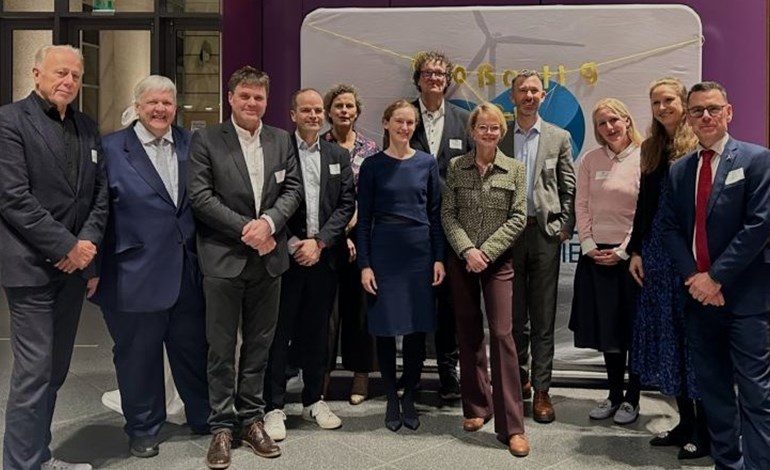
Ceremony hears calls for support and investment certainty
The German offshore wind group Stiftung Offshore-Windenergie celebrated its 20th anniversary with a ceremony at the British Embassy in Berlin.
The foundation said representatives from politics, science and business discussed milestones, current developments and future challenges.
Keynote speaker Jurgen Trittin praised its work as “a reliable voice for offshore wind energy” and said: “In 20 years, offshore wind energy has developed from an expensive niche technology to a global, competitive key industry.”
He said: “Offshore is a pillar of climate protection and employs 50,000 people in Germany.”
The foundation said it has shaped offshore wind expansion since 2005 through work on the alpha ventus test field, standards, acceptance and political frameworks.
Martin Gerhardt of Siemens Gamesa warned: “In order for offshore wind energy to fulfil its role in the energy transition, we have to act now: The 17 GW of projects that are still awaiting a final investment decision need functioning PPA markets and political support.”
He said: “For future projects, the introduction of CfDs (so-called Contracts for Difference) as a proven instrument is crucial.”
Kathryn Boyd of the British Embassy said the UK has longstanding experience in optimising its investment framework.
The foundation said Germany’s Federal Ministry for Economic Affairs and Energy aims to provide planning and investment security in the next Offshore Wind Energy Act amendment.
Chairwoman Dr. Ursula Prall said: “In the coming years, the Offshore Wind Energy Foundation will remain a strong voice for a reliable and future-oriented expansion of offshore wind energy.”
She said: “We will continue to advocate for a tender design that is conducive to expansion, stable framework conditions for maintaining the diversity of actors and close cooperation between all stakeholders nationally, Europe-wide and internationally.”
She added: “In this way, offshore wind energy will continue to be a driver of innovation, a guarantor of security of supply and a driver of a climate-neutral industrial society in the future.”
